Case FilesPublished veterinary case
How a Rottweiler with knee arthritis got back to running a mile
At one visit his owner said he could run a mile. Later, even walking that mile left him sore for days. A vet followed the same Rottweiler for five years.
The wider question: Has anyone tested BPC-157 in dogs with arthritis?
On this page
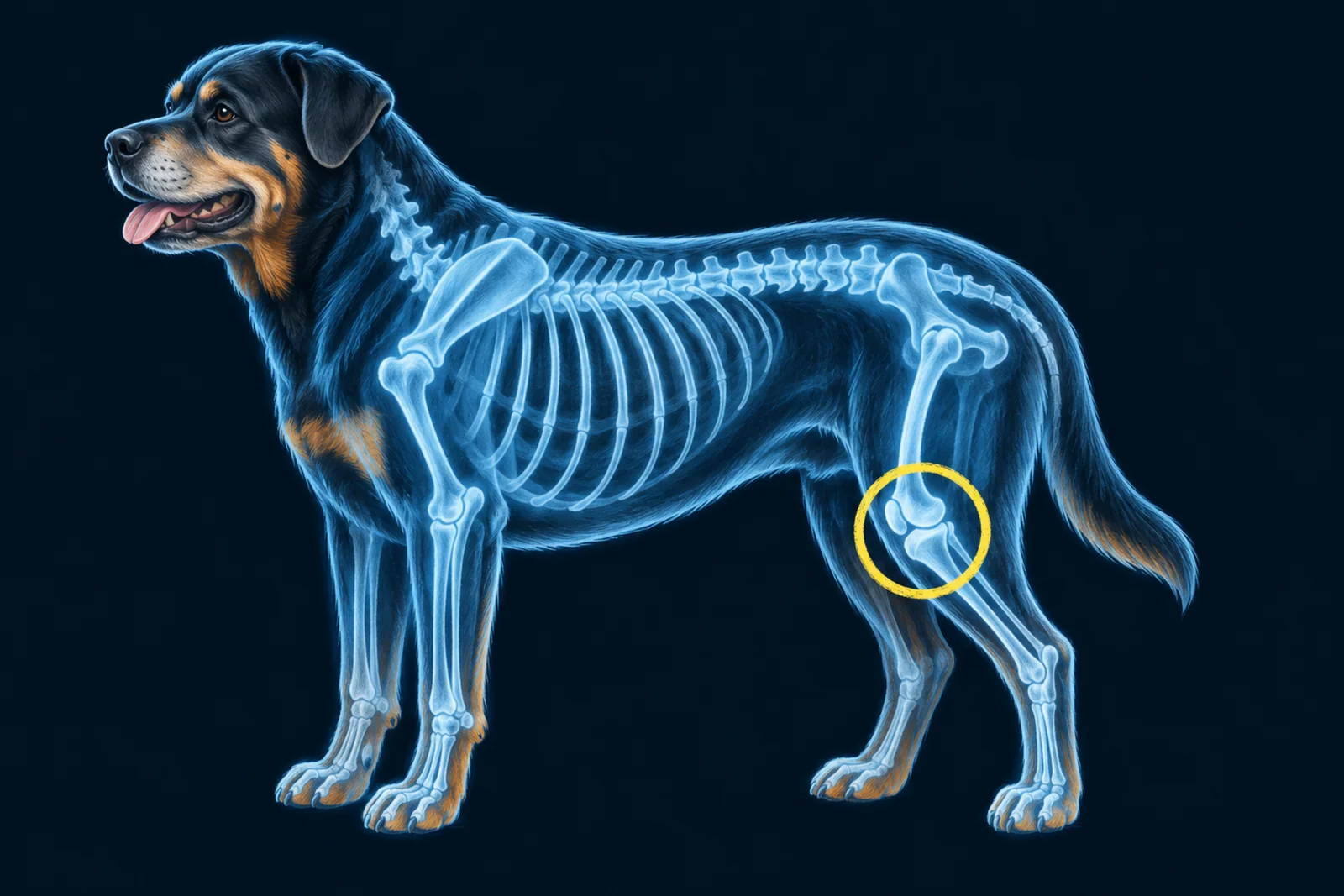
At the first visit, the Rottweiler sometimes put only his toes down as he got up. His right knee had been operated on two years earlier. This time, the limp came from the left.
More than two years later, his owner said he could regularly run a mile. At a later visit, the owner said a mile-long walk could leave him struggling to rise for days. All three observations appear in a case series by veterinarian Shelby A. M. Watson. Here's how the visits fit together.
On file
- Dog
- Rottweiler, neutered male, 6 years old at the first visit. Not named in the paper.
- Starting point
- Two years of on-and-off limping in the left hind leg. The right knee had surgery two years earlier.
- Diagnosis
- Cranial cruciate ligament disease in the left knee, a working diagnosis from exam and X-rays. Advanced osteoarthritis in the right knee.
- Reported by
- Shelby A. M. Watson, DVM, from the clinic's records.
- Published
- Journal of the American Holistic Veterinary Medical Association, volume 77, Winter 2024.
- Followed for
- Five years, to age 11.
What happened, in order
First visit
Reported by the treating vet, on examination
Limping at a walk, graded 3 out of 6, and briefly toe-touching after getting up. Weight 56 kg, rated overweight.
Also going on Short courses of two pain medicines, a herbal formula, laser sessions, less kibble with a daily fresh meal, omega-3s and home exercises all start here.
10 weeks Change
Reported by the treating vet, on examination and X-ray
No change in weight or signs. X-rays show advanced osteoarthritis in the right knee and a swollen, unstable left knee. BPC-157 by injection is added.
Also going on The herbal formula is repeated and the diet is now partly raw. The owner books knee surgery.
7 months
Reported by the owner, relayed by the vet
Back in after re-injuring the same leg. Looking back, the owner says the limp went away after the first BPC-157 course and that the surgery was cancelled because of it. No lameness grade was recorded.
Also going on The herbal formula restarts, a herbal anti-inflammatory is added, and a second BPC-157 course is given by mouth.
End of the second course
Reported by the owner, relayed by the vet
By phone, the owner reports the dog's best mobility in years.
2.5 years
Reported by the vet on examination, and the owner
Weight is down to 48 kg. The owner says the dog can regularly run a mile.
4 years
Reported by the vet on examination, and the owner
Diagnosed with degenerative joint disease in the knees and elbows. The owner reports two to three days of trouble getting up after one-mile walks. Weight 45 kg.
Also going on The diet is back to kibble. A daily anti-inflammatory medicine starts.
5 years, age 11
Reported by the treating vet, on examination
Marked muscle loss in both hind legs and thickening of both knees. Weight 42 kg, now rated thin.
Also going on A second pain medicine starts. The owner is also giving CBD.
What else was going on, in one list
- Less kibble, a daily fresh meal and omega-3s. He went from 56 kg to 42 kg over five years.
- Laser sessions over the first seven weeks.
- A Chinese herbal formula at three points, and a herbal anti-inflammatory from seven months.
- Short courses of two pain medicines at the start, then daily ones from year four.
- Range-of-motion exercises at home.
- No TB-500 and no platelet-rich plasma, unlike the other three dogs in the report.
How was he the morning after the walk?
At four years, his owner could put a number on the cost of a long walk. After a mile, the dog sometimes struggled to stand up for two or three days. If you only heard how far he walked, you’d miss the part that mattered once they got home.
For the next vet visit, jot down how far your dog walked and how easily they got out of bed afterward. Our guide to recording mobility at home shows what to include in a short video.
Why did the owner cancel his surgery?
The owner had booked surgery for the left knee. When the limp cleared up after a course of BPC-157, the owner called it off. They told Watson about that decision at the seven-month visit, when the dog was back with a fresh injury to the same leg. Over the longer stretch Watson also credits weight loss, diet changes and herbal therapy. The cancelled appointment tells you just how different the dog looked to the person who lived with him.
The other three dogs in the report
This is the first of four cases in Watson's 2024 paper: a 10-year-old Dachshund mix, an 11-year-old Jack Russell Terrier and a 5-year-old Australian Shepherd follow. All three also received TB-500 or platelet-rich plasma, so this Rottweiler is the only dog whose peptide care was BPC-157 alone. The paper's title describes all four as successful outcomes, which tells you how they were chosen.